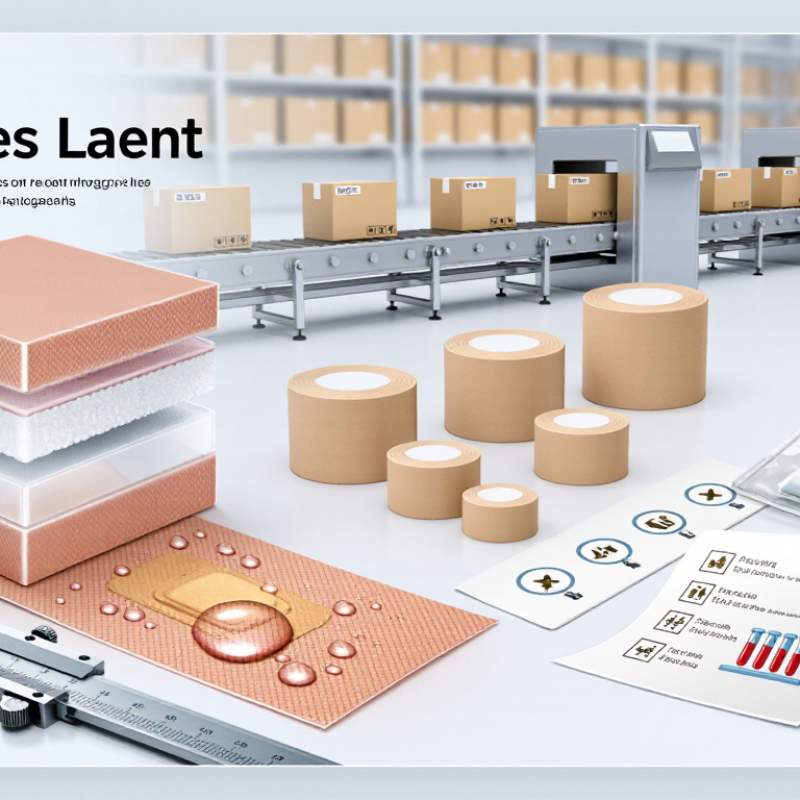
China Top Bandage Manufacturer for Global Buyers?

Can China become the top Bandage Manufacturer for global buyers? The opportunity is substantial, but the answer is not automatic. Grand View Research estimates that the global wound care market reached approximately USD 21 billion in 2023. It also expects continued growth through 2030, driven by ageing populations, diabetes, surgery, and home treatment. Adhesive bandages remain simple products. Their quality is not simple.

A reliable supplier must control adhesive strength, skin comfort, absorbency, sterility, packaging, and batch traceability. Picture a carton leaving a factory: every dressing should remain sealed, dry, and identifiable after transport across humid ports and cold warehouses. That practical detail often matters more than a low quotation. ISO 13485 certification can support quality management, but certification alone does not prove consistent production. Buyers still need audits, test reports, samples, and clear complaint procedures.

Wound-care specialist Professor David G. Armstrong has described the diabetic foot as “a barometer of systemic disease.” His observation reminds manufacturers that a small dressing may serve a serious clinical need. A strong China Bandage Manufacturer should therefore combine production scale with evidence-based material selection and responsive technical support. Experience matters here.

Still, some claims deserve more testing. “Premium” is not a performance measurement. Neither is “factory direct.” Global buyers should compare peel adhesion, moisture resistance, biocompatibility evidence, packaging validation, and delivery records. Reports show market growth, not guaranteed supplier reliability. That gap is where careful sourcing begins.

China Top Bandage Manufacturer for Global Buyers?

China’s Role in the Global Bandage Manufacturing Industry

China’s role in the global bandage manufacturing industry has expanded steadily. Manufacturers produce adhesive strips, sterile pads, elastic wraps, and specialized wound dressings. Many factories combine automated cutting with manual inspection. This balance supports large orders and varied packaging requirements. From industry sourcing experience, consistent specifications matter more than attractive samples. A bandage may look simple. Yet adhesive strength, absorbency, edge sealing, and skin comfort require controlled testing. Export-oriented suppliers often maintain quality systems and traceable batch records. However, capabilities differ widely, so buyers should verify evidence rather than trust claims.

Global buyers can benefit from competitive production costs and flexible customization. They may request different sizes, materials, absorbency levels, or carton quantities. Reliable cooperation depends on clear technical files and realistic production schedules. Ask for recent test reports, inspection records, and sample approval procedures. Confirm whether sterilization uses qualified processes and documented release checks. Packaging should withstand humidity, long transport, and warehouse handling. Small details reveal professionalism. Still, no factory is perfect. A supplier may pass one inspection and miss a later shipment target. That risk deserves honest discussion, not polished promises.

Tips: Compare at least three manufacturers using the same specification sheet. Check production capacity, quality records, complaint handling, and export experience. Request pre-shipment inspection for early orders. Keep approved samples and signed specifications together. If communication feels vague, pause. Trust grows through repeated evidence, not one video call.

Key Criteria for Identifying a Top Chinese Bandage Manufacturer

A top Chinese bandage manufacturer should prove more than a competitive quotation. Buyers need evidence of stable production, careful quality control, and dependable communication. An established quality system, such as ISO 13485, can indicate structured medical-device processes. However, a certificate alone is not enough.

Inspect the factory’s production areas, material storage, and packaging lines. Look for clean workstations, labeled batches, and controlled environmental conditions. Request samples from different production lots.

Check adhesive strength, absorbency, flexibility, skin contact materials, and package sealing. For sterile products, review sterilization records and related test reports. Small details matter.

Ask how the manufacturer handles raw-material changes, rejected products, complaints, and product recalls. Clear lot traceability should connect finished cartons with production records. Export experience also matters, especially when documents, labeling, and shipping schedules require accuracy. A practical supplier should provide technical files, inspection reports, and realistic lead times.

Communication reveals capability. Does the team answer technical questions directly? Are risks explained before an order is placed? A factory tour or independent audit can expose gaps that brochures hide. Even experienced buyers can overvalue low prices. I have seen attractive samples fail during longer storage or repeated handling. That possibility deserves honest discussion, not optimistic promises. A strong manufacturer keeps improving, because one unnoticed defect can affect thousands of daily-use bandages.

Bandage Product Types and Manufacturing Capabilities in China

China Top Bandage Manufacturer for Global Buyers?

China’s bandage sector supports diverse product programs for hospitals, pharmacies, distributors, and first-aid suppliers. Common types include adhesive strips, gauze pads, elastic wraps, cohesive bandages, waterproof dressings, and hydrocolloid patches. Materials may include cotton, nonwoven fabric, PU film, latex-free elastic, and skin-friendly acrylic adhesive. Each option serves a different need. Breathability matters for daily wear. Strong adhesion matters during movement.

Manufacturing capability depends on more than automatic machines. A capable facility can cut, coat, laminate, fold, print, seal, and pack products in controlled stages. Buyers may request custom sizes, shapes, colors, absorbency levels, cartons, or individual pouches. Some factories handle sterile production and validated sterilization through qualified partners. Reliable suppliers should provide material specifications, batch traceability, inspection records, and test results for adhesion, absorbency, aging, and package integrity. ISO 13485-based systems can support consistent medical-device production, but certification alone proves little without practical records.

Small details often decide the order’s success. A bandage can look excellent yet curl at the edges after storage. A softer adhesive may reduce irritation but lose grip in humid conditions. This trade-off deserves testing, not assumptions. I would ask for samples from several production lots, not one perfect sample. Factory audits, clear change-control procedures, and honest communication also matter. Not every factory suits every market, and a low quotation can hide higher inspection or rework costs.

China Bandage Manufacturing Capabilities for Global Buyers

Typical commercial width ranges for major bandage product categories commonly manufactured in China. Actual specifications may vary according to buyer requirements, materials, packaging, and target-market regulations.

Adhesive strips are usually produced in compact consumer sizes, while gauze rolls, elastic bandages, cohesive wraps, and tubular bandages support broader width customization for clinical, sports, and industrial applications.

Quality Standards, Certifications, and Buyer Compliance Requirements

A China-based bandage manufacturer should prove compliance before discussing price or production capacity. The WHO Global Patient Safety Report 2024 states that about one in ten patients experiences harm during healthcare. More than half of this harm is considered preventable. That makes material safety, cleanliness, and traceability practical buyer concerns.

For global buyers, ISO 13485 certification should cover the actual factory, product scope, and current certificate dates. Ask for the notified-body or certification-body details. Request batch records, sterilization validation, biocompatibility evidence, and adhesive testing. A reliable supplier can show how one carton links to raw-material lots and inspection results. During sampling, check seal strength, fiber shedding, package labels, and skin-contact warnings. Small details often reveal larger system weaknesses.

Market access also depends on destination rules. Buyers selling in the European Union should review Medical Device Regulation classification, technical documentation, clinical evaluation, and post-market surveillance duties. Buyers entering the United States should confirm applicable device listing, establishment registration, labeling, and quality-system requirements. A certificate alone is not proof of compliance. I would treat an unclear test report as a warning, even when the factory looks modern. Certificates may expire, scopes may be narrow, and translated documents can lose important details. The FDA’s annual device reporting data also shows why complaint handling and adverse-event procedures must be documented, not merely promised.

China Top Bandage Manufacturer for Global Buyers? - Quality Standards, Certifications, and Buyer Compliance Requirements

A practical due-diligence framework for evaluating Bandage Manufacturers, product quality, regulatory documentation, and export readiness. Requirements may vary according to product type, intended use, destination market, and local medical-device regulations.

Evaluation Dimension Typical Requirement or Applicable Standard Objective Evidence to Request Buyer Compliance Checkpoint
Regulatory Classification Required
Confirm whether the product is classified as a medical device, general consumer product, wound dressing, sterile device, or another regulated category in the destination market.
Product classification statement, intended-use description, technical documentation, and applicable regulatory pathway. Do not rely on the product name alone. Verify classification with the importer, authorized representative, or competent authority where required.
Quality Management System Recommended
ISO 13485:2016 is the internationally recognized quality-management standard for organizations involved in medical-device design, production, storage, distribution, installation, or servicing.
Current ISO 13485 certificate, certification scope, issuing certification body, validity dates, and audit status. Ensure the certificate covers the relevant product category and manufacturing site. Check that the legal entity and address match the exporter and factory records.
Good Manufacturing Controls Required
Production should be controlled through documented procedures covering incoming materials, process controls, environmental conditions, inspection, release, complaints, and corrective actions.
Quality manual, manufacturing procedures, batch records, inspection plans, nonconformity records, CAPA records, and internal-audit summaries. Confirm that procedures are implemented in practice through a remote or on-site audit, rather than accepting certificates as the only proof of control.
Raw Material Control Required
Materials such as nonwoven fabric, cotton, adhesive, release liner, backing film, packaging film, and absorbent pads should be specified and traceable.
Material specifications, supplier qualification records, certificates of analysis, incoming inspection results, and lot-traceability records. Verify material composition, country-of-origin requirements, latex status, skin-contact suitability, and any restrictions on dyes, plasticizers, or other substances.
Biocompatibility and Skin Contact Conditional
Products that contact skin or wounds may require biological evaluation. ISO 10993 is commonly used as a framework for evaluating biological safety of medical-device materials.
Biological evaluation plan or report, cytotoxicity testing where applicable, irritation or sensitization data, and material safety information. Confirm that testing reflects the final finished product, actual contact duration, adhesive system, sterilization method, and intended patient population.
Sterility Claims Conditional
Sterile bandages require a validated sterilization process and suitable sterile-barrier packaging. Common sterilization methods include ethylene oxide, radiation, or moist heat, depending on product design.
Sterilization validation, process monitoring records, residual testing where applicable, sterile-barrier validation, and sterility-maintenance data. Confirm the labeled sterility method, sterility assurance level claim, packaging configuration, shelf life, and transport conditions for the destination market.
Absorbency and Fluid Handling Conditional
Wound dressings and absorbent bandages should have defined performance requirements for absorbency, fluid retention, fluid handling, and dressing integrity.
Test method, sample conditioning, acceptance criteria, laboratory results, batch records, and comparison between approved samples and mass production. Require product-specific test data rather than generic fabric data. Confirm that the testing method matches the intended wound-care application.
Adhesive Performance Required
Adhesive performance should remain suitable for the intended application while supporting secure attachment, clean removal, and acceptable skin compatibility.
Peel or adhesion test results, aging data, skin-contact assessment, storage-condition data, and adhesive-batch traceability. Approve samples under realistic conditions, including humidity, temperature, application time, removal, perspiration, and movement where relevant.
Packaging Integrity Required
Packaging should protect the product from contamination, moisture, physical damage, and loss of performance throughout storage and distribution.
Packaging specifications, seal-strength testing, leak or integrity testing where applicable, transport simulation, and artwork-control records. Review packaging after simulated shipping and verify that pack size, labeling, lot code, expiry date, and opening instructions remain legible and intact.
Shelf Life and Stability Required
The claimed shelf life should be supported by stability data covering adhesive performance, packaging integrity, material condition, sterility where applicable, and product functionality.
Real-time stability data, accelerated-aging protocol, test intervals, acceptance criteria, and expiry-date justification. Ensure the expiry period is supported for the final commercial packaging and storage conditions specified on the label.
Product Testing and Release Required
Each production lot should be released against documented specifications for dimensions, appearance, materials, adhesive properties, packaging, and sterility where applicable.
Final inspection records, certificate of conformity, batch-release checklist, sampling plan, calibration records, and retained-sample procedure. Define critical-to-quality characteristics, sampling levels, acceptable quality limits, and procedures for handling rejected or reworked goods before purchase.
Labeling and Instructions Required
Labels and instructions should accurately state intended use, application method, warnings, storage conditions, lot or batch identification, expiry date, and sterility status when relevant.
Approved artwork, multilingual label review, instructions for use, symbol justification, traceability format, and regulatory labeling checklist. Confirm compliance with destination-market language, symbols, importer details, UDI or other identification rules where applicable, and prohibited medical claims.
Traceability and Recall Readiness Required
The manufacturer should be able to trace raw materials, production batches, packaging components, inspection results, shipments, and complaint records.
Lot-number structure, traceability procedure, mock-recall report, distribution records, complaint log, and corrective-action process. Test whether a specific shipment can be traced back to raw-material lots and forward to all affected customers within a defined response time.
Environmental and Chemical Compliance Conditional
Destination markets may impose restrictions on substances, packaging materials, chemicals, waste, and environmental claims. Requirements depend on product composition and sales territory.
Material declarations, restricted-substance statements, safety data where applicable, packaging composition, and market-specific compliance documents. Obtain written declarations for the target market and avoid unsupported claims such as “eco-friendly,” “non-toxic,” or “hypoallergenic.”
Factory Qualification Recommended
A qualified facility should have controlled production areas, suitable equipment, trained personnel, preventive maintenance, calibration, and documented sanitation controls.
Factory profile, process-flow diagram, equipment list, training records, calibration certificates, maintenance logs, and audit findings. Confirm the actual manufacturing site, subcontracted processes, production capacity, minimum order quantity, lead time, and contingency arrangements.
Pre-Shipment Inspection Recommended
Independent or buyer-authorized inspection can verify quantity, workmanship, dimensions, packaging, labeling, carton marking, and selected functional tests before shipment.
Inspection plan, approved reference sample, inspection report, photographs, carton measurements, and nonconformity disposition. Set acceptance criteria in the purchase contract and require written approval for deviations, substitutions, rework, or changes to approved materials.
Change Control Required
Changes to materials, adhesive, equipment, process parameters, packaging, sterilization, site, or subcontractors should be evaluated and documented before implementation.
Change-control procedure, change-notification form, risk assessment, validation results, and customer-approval records. Include advance-notification and requalification clauses in the supply agreement, especially for sterile products and regulated-market sales.
Important: ISO 13485 certification, test reports, and other documents do not automatically prove that a product is legally marketable in every country. Buyers should verify the destination market’s medical-device registration, importer obligations, labeling rules, conformity-assessment pathway, and post-market requirements before placing a commercial order.

Sourcing, Customization, and Export Considerations for Global Buyers

China Top Bandage Manufacturer for Global Buyers?

Global bandage demand is growing, but price alone cannot identify the right supplier. Mordor Intelligence estimates the adhesive bandages market at about USD 4.9 billion in 2024, with continued growth through 2029. This expansion increases sourcing options, but also increases verification work. Buyers should compare absorbency, adhesive strength, skin compatibility, packaging, and production capacity. A factory sample may look excellent. Its second batch may not.

Customization should begin with the intended use. Specify dimensions, backing material, wound-pad structure, adhesive type, sterilization method, and shelf life. Ask for material specifications and batch-level inspection records. ISO 13485-based quality systems can indicate controlled medical-device production, but certification alone proves little. Review its scope and issuing body. One overlooked detail is often the packaging seal.

Export preparation requires more than cartons and shipping documents. Request a commercial invoice, packing list, certificate of origin, product test reports, and clear labeling files. Import rules differ by destination, so the buyer should confirm classification and registration duties locally. Reports from Grand View Research place the global wound care market above USD 20 billion in recent assessments, showing why regulatory expectations are becoming stricter. An experienced manufacturer should explain lead times, minimum order quantities, storage conditions, and complaint handling without vague promises. The cheapest quotation is sometimes the most expensive correction.